
Editor Elena Patera
Welcome to the August issue of Anastomosis. In this issue, we bring you the latest news from our members and from the Journal of Anatomy and Aging Cell.
If you have any news, events or announcements that you would like to see published in the newsletter, please send us an email by the 20th of each month. Items should reach the editor a minimum of 30 days before the date that the event is scheduled to take place. Please remember that you can visit our News Page at any time for the very latest news.
Education Committee Paper of the Month
‘Empowering anatomists at all career stages: The vital role of reflective practice for professional growth’'
Authors: Elena Patera, Olga Avilova, Bipasha Choudhury, Dianne Burns
Access the article here: https://doi.org/10.1002/ase.70271
The summary below is provided by Elena Patera (Human Anatomy Resource Centre, University of Liverpool, UK)
Have you ever wondered how often we hear about ‘reflective practice’ in our day-to-day job?
Do we only get to hear about reflective practice when it’s time for our annual progress review or as part of an application for a promotion?
These questions are particularly relevant in anatomy education, given the diverse pathways through which anatomists enter the profession. It might be safe to assume that many anatomists enter academia without having received any formal training in pedagogy. Whilst they may have the most advanced anatomical knowledge, can we assume that they have the skills to teach students effectively, to design effective instructional material that is informed by research-based guidelines, or to identify their own biases and how their perceptions of the world may affect their teaching practice and subsequently their learners’ experience?
Supporting the professional growth of anatomy educators is an investment in the future of anatomy, and it is a long-term commitment that can be influenced by multiple factors:
- Institutional support
- Personal professional development
- Culture of reflective practice
Engaging in critical self-reflection is not simply about examining the technical aspects of teaching. Instead, educators are challenged to consider their underlying assumptions, biases, and values, and how these shape their students' experience.
But how can educators translate critical self-reflection into their everyday practice? Have you ever heard of a teaching philosophy statement, the ‘teaching squares’ approach, or a teaching portfolio? If not, you can read our article, in which we recommend three potential strategies that anatomy educators can use as part of their reflective practice toolkit.
These practical recommendations are summarized below:
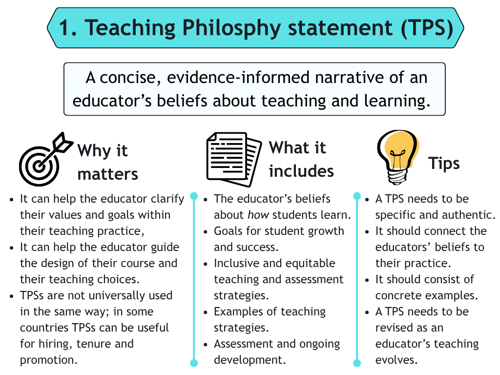
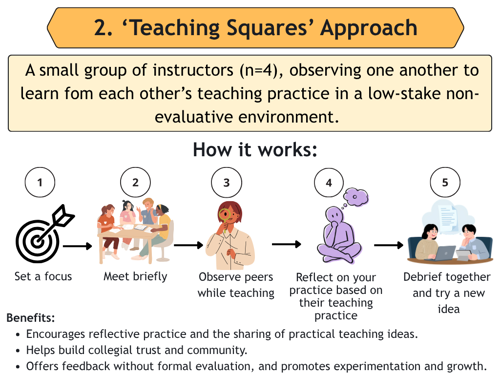
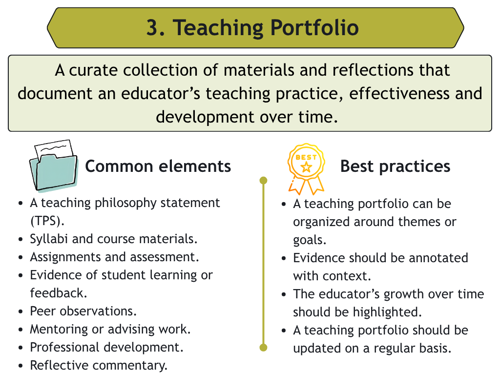
These three strategies offer practical ways to make reflective practice part of your professional journey. If you are unsure about how to get started, the important thing is to start! You can, for example, start by taking reflective notes after a session you have delivered, or during the process of designing a new module. Although there are several models for reflective practice, in our viewpoint commentary, we also discuss two particular models: (1) Gibbs’ Reflective Cycle and (2) Brookfield’s four lenses model.
Perhaps a common misconception is that reflection is needed when ‘things go wrong’; however, reflection is equally important for examining positive outcomes. Anatomy departments must play an active role in promoting educators’ engagement with reflective practice by creating time, space, and structures that encourage reflection. At the same time, anatomy educators themselves must take personal responsibility to engage in reflection individually, ensuring it becomes a regular and intentional part of their own practice.
The Anatomical Society Prize Winner 2025
Congratulations to Emeritus Professor John Morris for being awarded the Anatomical Society Prize 2025!
Professor John Morriss is an Emeritus Professor of Human Anatomy in the Department of Physiology, Anatomy and Genetics at the University of Oxford. His career as a leading British anatomist and neuroendocrinologist has been marked by major contributions to both anatomical science and medical education. His research interests throughout his career have been in structural studies in neuroendocrinology, especially vasopressin and oxytocin. His work demonstrated that peptide hormones are released by exocytosis, overturning earlier assumptions about molecular dispersion. He later identified how steroid hormones rapidly trigger peptide release from magnocellular dendrites - findings that have influenced modern neuroendocrinology. Alongside his research, Professor Morris is also deeply committed to education in functional and clinical anatomy and his impact and legacy is reflected by the different roles he served and awards he won. He served as Director of Preclinical Studies from 2004 to 2010 and is widely recognised for his exceptional teaching. His contributions were honoured with the Medical Sciences Division Lifetime Achievement Award for Teaching Excellence, reflecting his long-standing impact on generations of Oxford medical students. He is also co-author of the Oxford Textbook of Functional Anatomy, a foundational multi-volume resource for anatomical teaching. Professor Morris has played an important role in scientific leadership, serving as Chairman of the British Society of Neuroendocrinology and President of the Anatomical Society. He was also elected to the Fellowship of the Academy of medical Sciences in 2001.
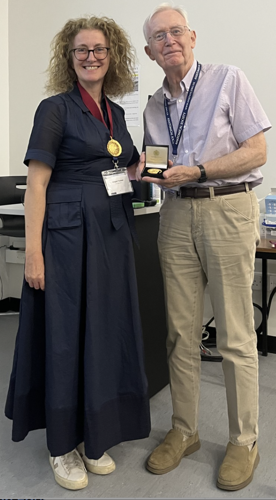
Photo: Emeritus Professor John Morris receiving his award medal from the Anatomical Society President, Professor Abigail Tucker, at the Summer Meeting 2026, Bristol.
Anatomical Society 2026 Cave Young Investigator Best Poster Prize Winner
Congratulations to Ms Louise Hosty for being awarded the Cave Young Investigator Best Poster Award, at the Anatomical Society Summer Meeting 2026 at the University of Bristol!
Presentation Title: Development of a pro-angiogenic hyaluronic acid hydrogel decorated with vascular cell-derived ECM
Submitted by: Ms Louise Hosty, Royal college of Surgeons in Ireland (RCSI), Dublin
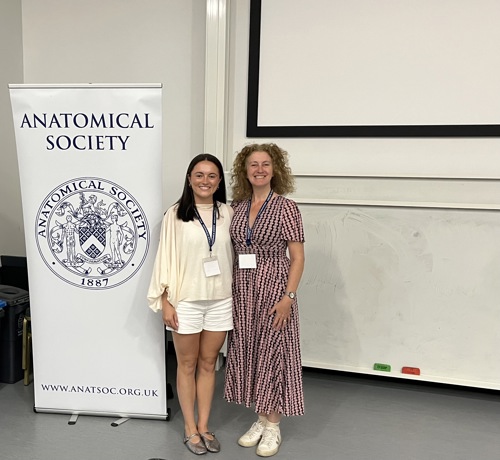
Photo: Ms Louise Hosty and the President of the Anatomical Society, Professor Abigail Tucker
Congratulations to the Latest Recipients of Anatomical Society Funding
If you would like to know more about how the Anatomical Society Funds our members, please see our full prize and funding matrix here. This month we would like to congratulate and latest recipients of the society's funding awards and provide you with the reports of the successful endeavours of recent awardees.
The Barclay-Smith Travelling Fund Recipients
The Anatomical Society awards the Barclay-Smith Travelling Fund to AS members to support their attendance at the Anatomical Society Winter or Summer meetings. You can read below the approved reports of recent awardees!
2025/26 Round 3
Ms Natalie Wucherer participated in FENS (Federation of European Neuroscientists) Forum 2026, Barcelona, Spain, 6th to 10th July 2026. REPORT
Ms Anandita Mariappan participated in the Anatomical Society Summer Meeting, University of Bristol, Bristol, 15th to 17th July 2026. REPORT
Mr Anas Sulaiman Alkharusi participated in the Anatomical Society Summer Meeting, University of Bristol, Bristol, 15th to 17th July 2026. REPORT
Mr Ryan Lukin participated in the Anatomical Society Summer Meeting, University of Bristol, Bristol, 15th to 17th July 2026. REPORT
Ms Lauren Barrett participated in the Anatomical Society Summer Meeting, University of Bristol, Bristol, 15th to 17th July 2026. REPORT Photo
2025/26 Round 4
Mr William Antcliff participated in the Anatomical Society Summer Meeting, University of Bristol, Bristol, 15th to 17th July 2026. REPORT
Dr Alannah Mortimer participated in the Anatomical Society Summer Meeting, University of Bristol, Bristol, 15th to 17th July 2026. REPORT
Ms Maricci Basa participated in the Anatomical Society Summer Meeting, University of Bristol, Bristol, 15th to 17th July 2026. REPORT
Ms Emily Baxter participated in the Anatomical Society Summer Meeting, University of Bristol, Bristol, 15th to 17th July 2026. REPORT
Ms Lorna Brockbank participated in the Anatomical Society Summer Meeting, University of Bristol, Bristol, 15th to 17th July 2026. REPORT
Ms Sumar Chan participated in the Anatomical Society Summer Meeting, University of Bristol, Bristol, 15th to 17th July 2026. REPORT Photo
Ms Alix Hudson participated in the Anatomical Society Summer Meeting, University of Bristol, Bristol, 15th to 17th July 2026. REPORT
Dr Juliette Hughes participated in the Anatomical Society Summer Meeting, University of Bristol, Bristol, 15th to 17th July 2026. REPORT
Anatomical Society Symington Bequest Travel Fund
The Trustees of the Symington Bequest Fund make grants to Society Members towards costs associated with the conduction and dissemination of anatomical research. Congratulations to our most recent awardees!
2025/2026 Round 2
Dr Isma Liza Mohd Isa participated in the 22nd Congress of the International Federation of Associations of Anatomists (IFAA), ‘Anatomy for Everyone’, Melbourne, Australia, 13th to 16th August 2026. REPORT
Ms Elena Patera participated in the 22nd Congress of the International Federation of Associations of Anatomists (IFAA), ‘Anatomy for Everyone’, Melbourne, Australia, 13th to 16th August 2026. REPORT
2025/2026 Round 3
Dr John Buchanan participated in the 22nd Congress of the International Federation of Associations of Anatomists (IFAA), ‘Anatomy for Everyone’, Melbourne, Australia, 13th to 16th August 2026. REPORT
Anatomical Society Public Engagement and Outreach Awards Reports
The Council of the Anatomical Society launched this initiative in June 2018 to support the public engagement and outreach activities of members of the Society in the field of Anatomy. Please read below the approved report of a recent awardee!
Year 2025/2026
Round 2
Awardee: Dr Ourania Varsou
Institution: University of Glasgow
Event dates: 3rd May 2026, 29th July 2026, 8th August 2026
Venue: Glasgow Riverside Museum, Glasgow
Activity Title: Breathing Like a Sci-Fi Villain: How Respirators Work with the Human Respiratory System – Developing a Sustainable Public Engagement Toolkit
REPORTS: 3rd May 2026, 29th July 2026, 8th August 2026
Anatomical Society Support for Student Societies
The Anatomical Society funds student societies to support them in a range of activities, including inviting a speaker and/or organising a seminar. Congratulations to our most recent awardee!
2025/26 Round 4
Awarded to: Ms Rishita Prabhu
Institution: University of Birmingham
Event Title and Date: International Surgical Anatomy Teaching Series (ISATS)
Location: Virtual MS Teams. A free 15-week series 30.09.26 to 27.01.27, Wednesdays 18:00 to 20:00
Deadlines for next round for Receipt of Applications
Award application deadline date for Round 1 of the 2026/2027 award year:
Symington Bequest
Barclay Smith Travelling Fund
Fellowship of the Anatomical Society
Public Engagement and Outreach
Departmental Seminar Awards
Deadline: 11.11.2026
Award application deadline date for Round 1 of the 2026/2027 award year:
Support for Student Societies
Deadline: 28.10.2026
For more information on the deadlines for all rounds of 2026/2027, and Round 1 of 2027/2028 please check out the tables below:
2026/27 Deadline dates | |||
Application Rounds NB There are 5 Rounds in 2026/27 |
Award application Deadline date for: (Deadline 2 weeks before Council)
|
Award Application Deadline Date for: support for Student Societies (Deadline 1 month before Council)
| Prizes and Awards Committee and Council Meeting dates are as follows |
Round 1 | 11.11.26 | 28.10.26 | 25.11.26 |
Round 2 | 18.02.27 | 04.02.27 | 03.03.27 |
Round 3 | 15.04.27 | 01.04.27 | 29.04.27 |
Round 4 | 28.06.27 | 14.06.27 | 12.07.27 |
Round 5 | 25.08.27 | 11.08.27 | 08.09.27 |
2027/28 Deadline dates | |||
Application Rounds NB There are 5 Rounds in 2027/28 | Award application Deadline date for: Symington Bequest, Barclay Smith Travelling Fund, Fellowship of the Anatomical Society, Public Engagement and Outreach, Departmental Seminar Awards and Dr Sophie Miller Memorial Prize (March Council) (Deadline 2 weeks before Council)
| Award Application Deadline Date for: support for Student Societies [This award is under review] (Deadline 1 month before Council)
| Prizes and Awards Committee and Council Meeting dates are as follows |
Round 1 | 09.11.27 | 26.10.27 | 23.11.27 |
Round 2 | |||
Round 3 | |||
Round 4 | |||
Round 5 | |||
Anatomical Society Online Master Class
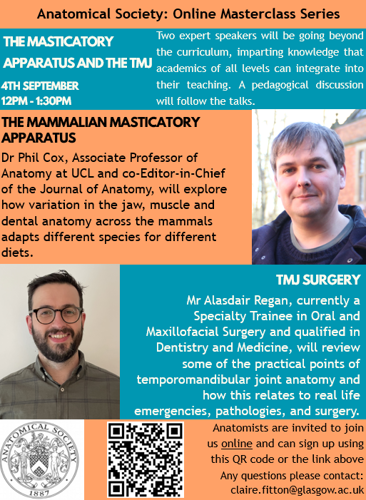
Anatomists and clinical staff from all relevant backgrounds are warmly invited to our next instalment of the Anatomical Society Education Committee’s Masterclass series on 4th September 2026, this time discussing the mammalian masticatory apparatus and the TMJ. Please see the poster for details and register to join via the QR code or this link
Upcoming Anatomical Society General Meeting Council
The Annual General Meeting of the Anatomical Society will be held on Tuesday 15th December 2026 at Trinity College Dublin, Ireland during the Society’s Winter Meeting, 14th to 16th December 2026.
Exact time of the AGM will be announced later.
Tribute to Professor Harold Ellis
The following tribute has been written by Professor D. Ceri Davies
In Memoriam, Professor Harold Ellis
Professor Harold Ellis died on 25th March 2026 in his 101st year. He was probably the most influential anatomy educator of the last 70 years and influenced literally tens if not hundreds of thousands of medical students and trainee surgeons throughout the world, as well as medical education policy.
Henry Ellis (later renamed Harold) was born in Stepney Green in the East End of London in 1926 to Jewish Emigres from what was Russia and is now Poland. His father was a barber and his mother ran a successful dress-making business although she never learnt to read or write. The youngest of four children, he won a scholarship to St Olave’s Grammar School Southwark, which was re-located to Torquay after the outbreak of the Second World War. He subsequently won a government scholarship to study medicine at the Queen’s College Oxford, where Wilfred Le Gros Clark was Dr Lee’s Professor of Anatomy and Solly Zuckerman was a lecturer in Anatomy. It is inconceivable that these great anatomists did not inspire and influence him.
Harold Ellis qualified as a doctor at the age of 22 years in July 1948, the same month that the National Health Service was established. He spent two years as a House Surgeon in Oxford and for his performance in the old Primary FRCS England examination he was awarded the Hallett prize for the best performance in the examination. I am not sure what the requirements for the prize were then, but the Hallett prize still exists and is awarded for the best performance in the year throughout the world in the MRCS England part A exam and the awardee must score over 90%, otherwise the prize is not awarded. In 1950 he was called up for National Service as a Captain in the Royal Army Medical Corps, spending much of his time treating casualties with severe spinal and cranial injuries suffered in the Korean war.
After National Service Professor Ellis was appointed Resident Surgical Officer at Sheffield Royal infirmary and that is where he started teaching medical students on his firm. In 1955 he took up the post of Surgical Registrar at the Westminster Hospital and then spent four years as Senior Registrar and Surgical Tutor at the old Radcliffe infirmary in Oxford. He returned to the Westminster Hospital as Consultant Surgeon and Senior Lecturer and two years later in 1960 he was appointed Professor of Surgery in the University of London (at that time all academic appointments in London Medical Schools were University of London appointments). The Westminster Hospital Medical School did not have preclinical students, recruiting clinical students mainly from Oxbridge and other preclinical Schools, but of course he continued teaching clinical anatomy as part of his role albeit in theatre and clinics. The Westminster Hospital then in Horseferry Road, was involved in a number of major incidents in Central London. In 1974 Professor Ellis as lead surgeon at the Westminster operated on Princess Anne’s bodyguard to remove shrapnel and repair a perforated bowel after her attempted kidnap. He also treated casualties from the IRA bombings in Hyde Park and Regents Park in 1982 and the Libyan Embassy siege in 1984.
After Professor Ellis retired from surgery in 1989 he began a second career (officially this time) as Clinical Anatomist first at the University of Cambridge and then at Guy’s Hospital Medical School (now Kings College London), where he continued working until 2020 in his 95th year, when he was persuaded to stop taking the tube into central London because of the COVID pandemic. Throughout his second career he eschewed computers, Powerpoint presentations and the like because he considered them to be distractions from the material at hand. He preferred blackboard and chalk, because their effective use required simplicity and clarity and therefore a greater understanding of anatomy. Perhaps there is lesson for us all in that view.
Professor Ellis’ appointment as Clinical Anatomist was hardly his first foray into teaching anatomy. The first edition of his popular textbook (Clinical Anatomy) was published in 1960. It is now in its 14th Edition and has been continuously in print for 66 years. It has sold hundreds and thousands of copies in 190 countries throughout the world. At the last count Professor Ellis published 27 books and more than 400 papers reflecting his interest in clinical anatomy, education and medical history. He was still working at home until shortly before his death. He saw the print copy of the 5th Edition of Human Cross-Sectional Anatomy before it was published in April 2026 and although he will not see it in print, he finished working on the 15th revision of Clinical Anatomy shortly before his death. Although he would not have allowed it in his lifetime, his co-author of the 15th edition, Vishy Mahadevan, informed me that in future it will be entitled Ellis’ Clinical Anatomy. It is a sobering thought that Professor Ellis taught anatomy as a retirement career for longer than most people teach anatomy as their primary occupation, he leaves a considerable legacy.
Professor Ellis was elected Vice President of the Royal College of Surgeons of England in 1986 and also served in a similar role in the Royal Society of Medicine. In 1987 he was appointed Commander of the Order of the British Empire for Services to Surgery. In 2011 he was awarded the Anatomical Society Prize and in 2013 awarded Honorary Fellowship of the Society in recognition of his services to Anatomy Education.
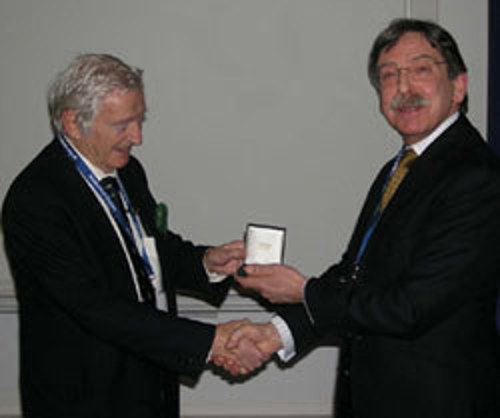
The image above shows past president of the Anatomical Society Professor D. Ceri Davies awarding Emeritus Professor Harold Ellis the Anatomical Society Medal in recognition of his teaching excellence at the Joint Meeting of the Anatomical Society with the British Association of Clinical Anatomists and the Institute of Anatomical Sciences at Cardiff University (December 19-21, 2011).
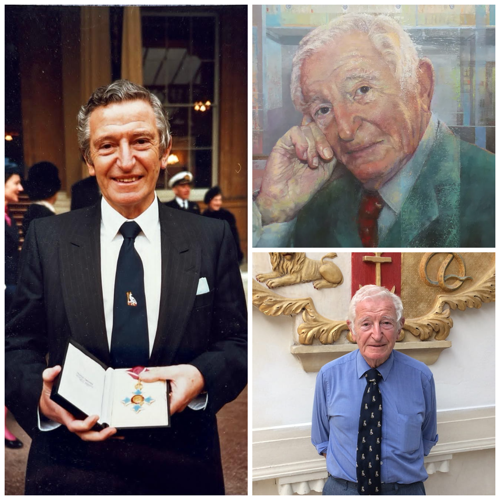
The collage above shows pictures and a painting of Professor Harold Ellis. The picture on the left shows Professor Ellis receiving the Commander of the Order of the British Empire (CBE) award in 1987.
Seeking a Reviewer: Oxford Textbook of Cardiac Anatomy
The Journal of Anatomy is seeking a reviewer for the newly published Oxford Textbook of Cardiac Anatomy.
If you are interested in reviewing the book, please contact the Journal of Anatomy at janat@dpag.ox.ac.uk for further details.
Anatomy Research Developmental Awards 2026/2027
The Anatomical Society Council is pleased to announce the 2026/27, 'Anatomy Research Development Award' aimed at researchers in the early stages of their academic careers.
Applications are currently being invited from eligible researchers to commence in 2027. The closing date for applications is midnight 31st December 2026.
Journal of Anatomy
For a summary of many of the published articles check out @JournalofAnat. As a member of the Anatomical Society you have access to these articles and to the Journal of Anatomy through Wiley Online Library.
Access the journal here.
The cover image for the latest issue is from a paper by Balzeau et al. (2026), titled 'The ‘Rosetta Stone’ of palaeoneurology: A detailed study of the link between the brain and the endocast on 75 volunteers'.
The study directly compared brains and endocasts in 75 living individuals, revealing that endocranial sulcal marks are typically short and discontinuous and that 12% are unrelated to brain sulci, thereby providing a more reliable, standardized framework for reconstructing brain anatomy and evolution in fossil hominins.
Access the paper here
The cover image for the journal's August issue is shown below:
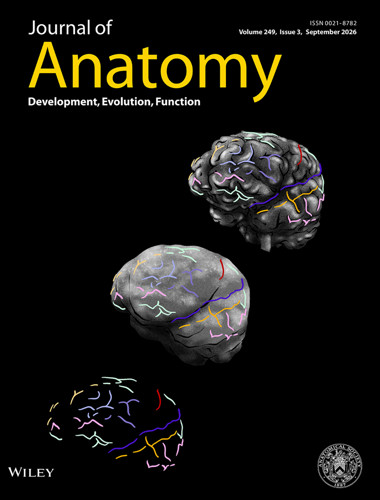
Cover image: How the brain helps to reveal the position of the sulci on the endocast (drawing by Tiphaine Derrey).
Aging Cell
Aging Cell is a bi-monthly peer-reviewed, open access journal that aims to publish the highest quality, innovative research addressing fundamental issues in the biology of aging. We would like to remind you that our colleagues Aging Cell are now back on X and sharing exciting news and updates on articles from their journal. Please give them a follow @aging_cell
Access the journal here: Aging Cell
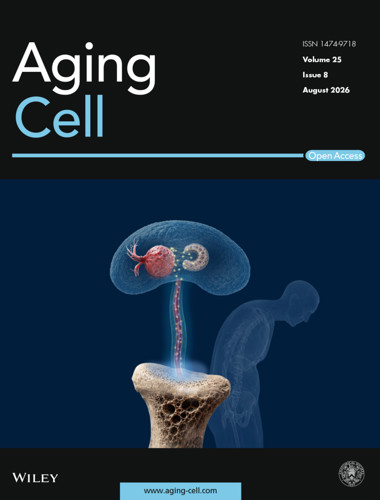
The cover image for the latest issue is from a paper by Zhong et al. (2026), titled 'Podocyte mPGES-2 Determines Renal Aging and Contributes to Senile Osteoporosis'.
The study investigated the role of mPGES-2 in renal aging, finding that its genetic deletion or pharmacological inhibition reduced kidney senescence and osteoporosis in aged mice, thereby identifying podocyte mPGES-2 as a promising therapeutic target for age-related kidney and bone disease.
Access the paper here
The cover image for the journal's August issue is shown below:
Vacancies
Assistant Professor in Anatomy (Education) For more information about this post please click here | Job Title | Assistant Professor in Anatomy (Education) x2 |
Contract Type: | Full time permanent | |
Organisation: | Department of Biomedical Sciences, College of Medicine and Health, University of Birmingham | |
Remuneration: | £47,389 to £56,535, with potential progression once in post to £63,606 | |
Closing Date: | 7th of September 2026 |